RITA reads the record, reasons through it like a colleague who's read every page, and shows her work — citing every finding back to the source instead of guessing.
RITA isn't here to replace the paralegals and legal nurse consultants who already know these cases cold. She's here to hand them a fully-cited first pass — record read, timeline built, findings sourced back to the page — so the person who signs their name to the work spends their time reviewing and judging, not scanning 1,400 pages of records to find the one line that matters.
Hours of chart review compressed to minutes, not replaced.
Every finding is a citation you can check, not a verdict.
Capacity to take on more work without burning out the people doing it.
Every RITA report is built on a simple rule: if it's not documented, she says so — instead of guessing.
Conclusions drawn from the record, not a summary or a search.
Every finding is cited back to its exact page in the record.
Abstains — "not in the record" — instead of guessing.
Deviation of care measured against the standards you upload.
Billing analysis computed from the charge lines, not estimated.
RITA runs locally — on your own infrastructure or within our closed-loop system — so your case files never leave a network you control.
From first merit screen to expert rebuttal, RITA covers the full lifecycle of a case.
Every sample above is a real RITA-generated report from a synthetic demo case — built to be shown, not staged.
Hover the dot on each page below. These are real excerpts from the sample packet — not cherry-picked wins. Some flag a problem, one confirms a clean record. That's the point.
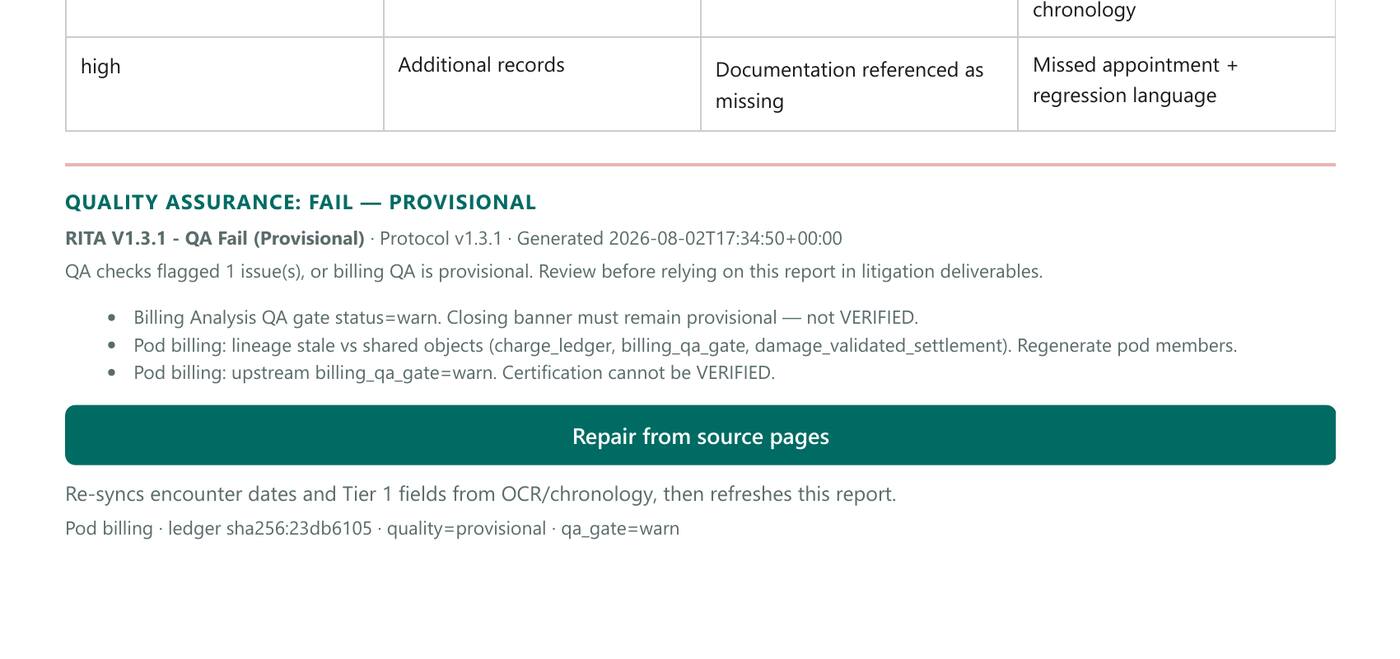
When the underlying data is provisional, the report is marked "QA Fail — Provisional" instead of presenting it as settled fact.
View full report →
Every scored finding comes with the plain-language boundary of what it is and isn't proof of.
View full report →
She'll draft the scaffolding, but she tells you plainly when it's a placeholder, not a rebuttal.
View full report →
Conflicting mechanism-of-injury accounts get called out explicitly, not smoothed over into one clean story.
View full report →
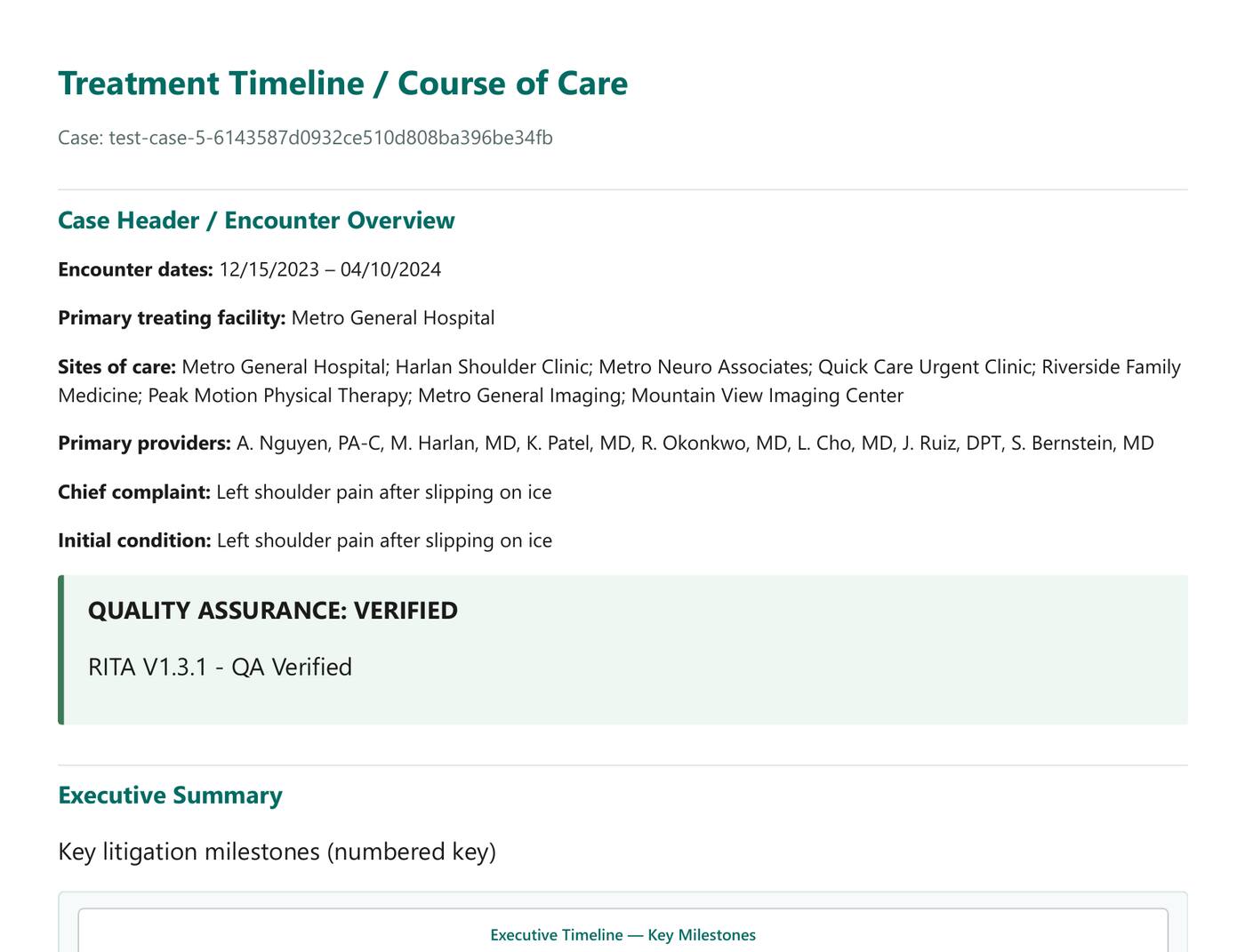
The honesty cuts both ways: this one passed every QA check, and the report says so just as plainly.
View full report →
The suggested range is deterministic scaffolding, not a legal opinion — and the letter says so in plain English.
View full report →RITA doesn't guess at strategy — she surfaces what the record already says, cited back to the page, so you can build the argument yourself. Every answer traces to a document. If it's not in the record, she tells you that too.
When a patient file comes in, it's processed entirely locally — no public cloud AI service ever sees it. That's how every case is handled today, and it's the foundation for where this is headed next.
The moment a patient file arrives, it's read and reasoned through entirely on local infrastructure — never uploaded to a public cloud AI service for analysis.
Because processing never leaves local infrastructure, protected health information is never exposed to a third-party cloud environment — in transit or at rest.
Your case is never sent to a shared or third-party AI model. The reasoning happens in one controlled, local process, start to finish.
The next step: a dedicated appliance installed inside your firm's own network — a physical box behind your firewall — so records never have to leave your building at all, not even to reach us. Updates arrive one of two ways, your choice: pushed over a brief internet connection, or delivered fully offline by USB with zero network exposure.
A portable, de-identified version of a case that drops into any AI assistant your firm already uses — on a laptop, a monitor, or your phone. Ask it anything, out loud or typed, the second you need it.
Send the records, typically a 24-hour turnaround — request a demo or account and see exactly what she does on a case that matters to you.
Request Information