Sample Reports

Twelve report types. One record.

Meet Jordan Avery, a synthetic case. From first merit screen to expert rebuttal, RITA covers the lifecycle of a case. Every sample below is a real, unstaged report she generated from that one file.

The Litigation Suite

Click any report to open the sample.

Built to be shown, not staged. Where a report failed its own quality check, the sample says so.

See For Yourself

What she says when the record isn’t clean.

Hover the dot on each page. These are real excerpts from the sample packet, not cherry-picked wins. Some flag a problem, one confirms a clean record, and one draws the line between her computation and counsel’s judgment.
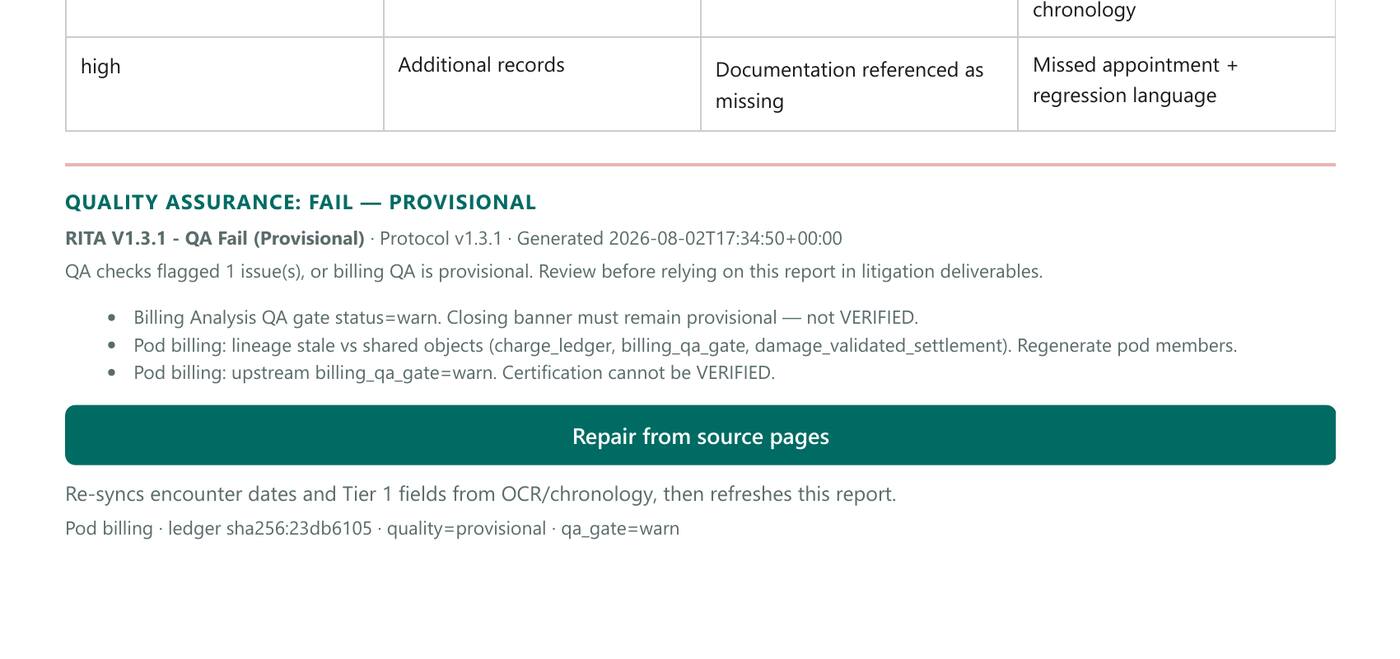
Merit Screen QA banner
This report failed its own QA check — and says so, right in the deliverable, instead of quietly shipping a shaky number.
She names exactly which upstream data made this report provisional — the charge ledger and the billing check that failed — not a vague "needs review."
Flag a problem, then hand you the one-click path back to source — not just a warning with nowhere to go.

Merit Screen — Fails Loudly, Not Quietly

When the underlying data is provisional, the report is marked "QA Fail — Provisional" instead of presenting it as settled fact.

View full report →
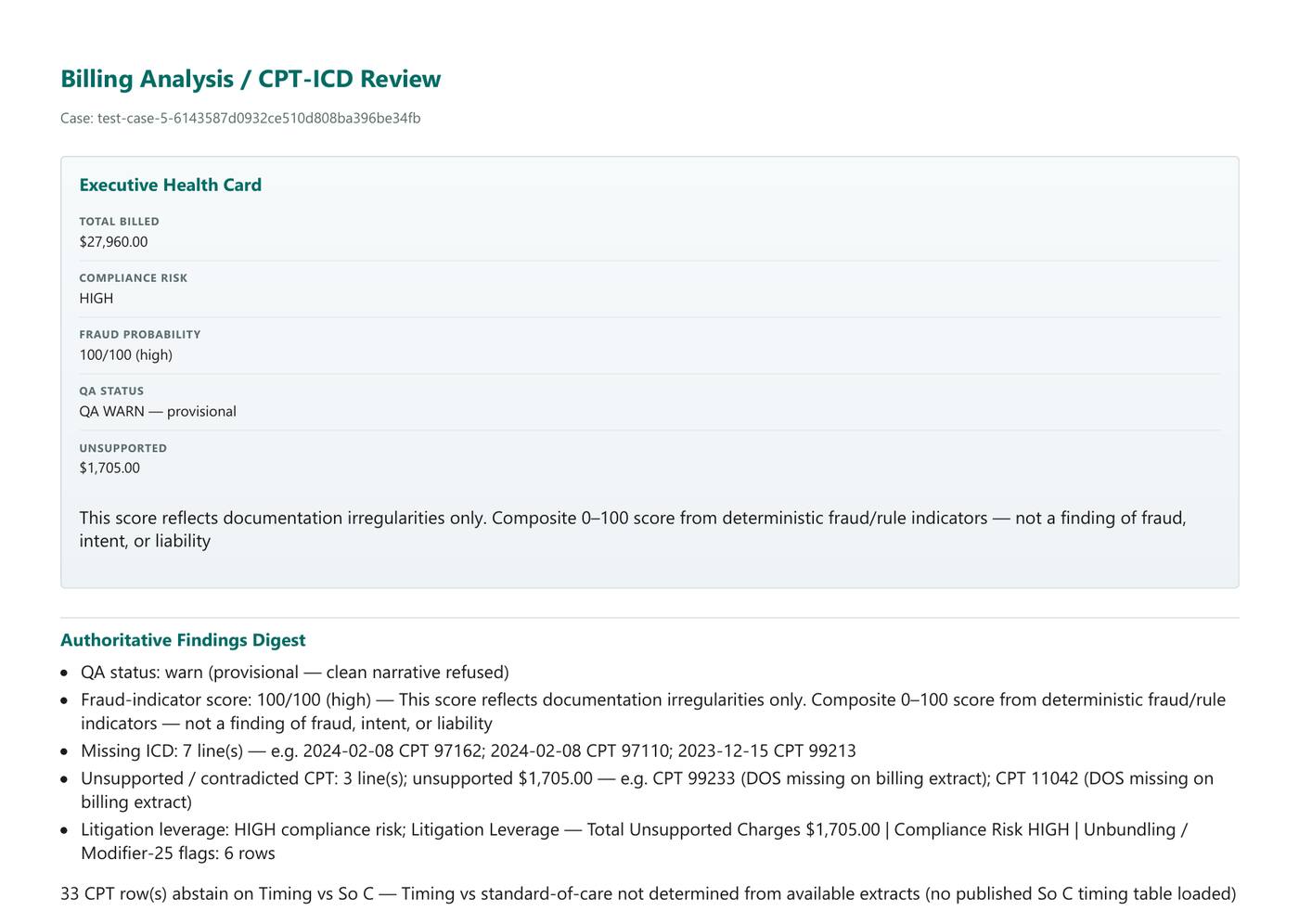
Billing Analysis QA status and fraud-score disclaimer
100/100 (high) — flagged right in the executive card, not buried in an appendix, so no one skims past it.
A 100/100 fraud-indicator score sounds damning — so RITA immediately clarifies what it does and doesn't mean, instead of letting the number speak for itself.
Every unsupported dollar traces to a named CPT code and the specific reason it's unsupported — not a lump-sum estimate.

Billing Analysis — Precise About What a Score Means

Every scored finding comes with the plain-language boundary of what it is and isn't proof of.

View full report →
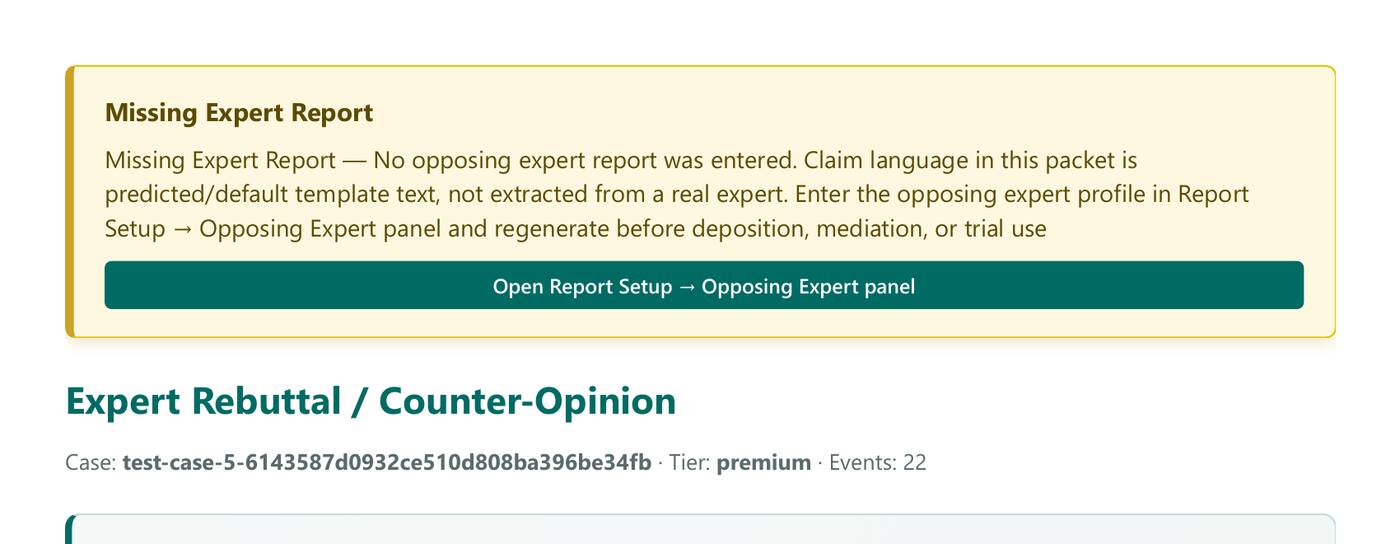
Expert Rebuttal missing expert report warning
No opposing expert report was loaded — so instead of inventing one, RITA flags the claim language as placeholder text until you load the real thing.
She's explicit that this is placeholder language standing in for a real opinion — not something quietly repackaged as if it were one.
Not just a warning — a direct link to the exact panel where you load the real expert report and regenerate.

Expert Rebuttal — Won't Fake What's Missing

She'll draft the scaffolding, but she tells you plainly when it's a placeholder, not a rebuttal.

View full report →
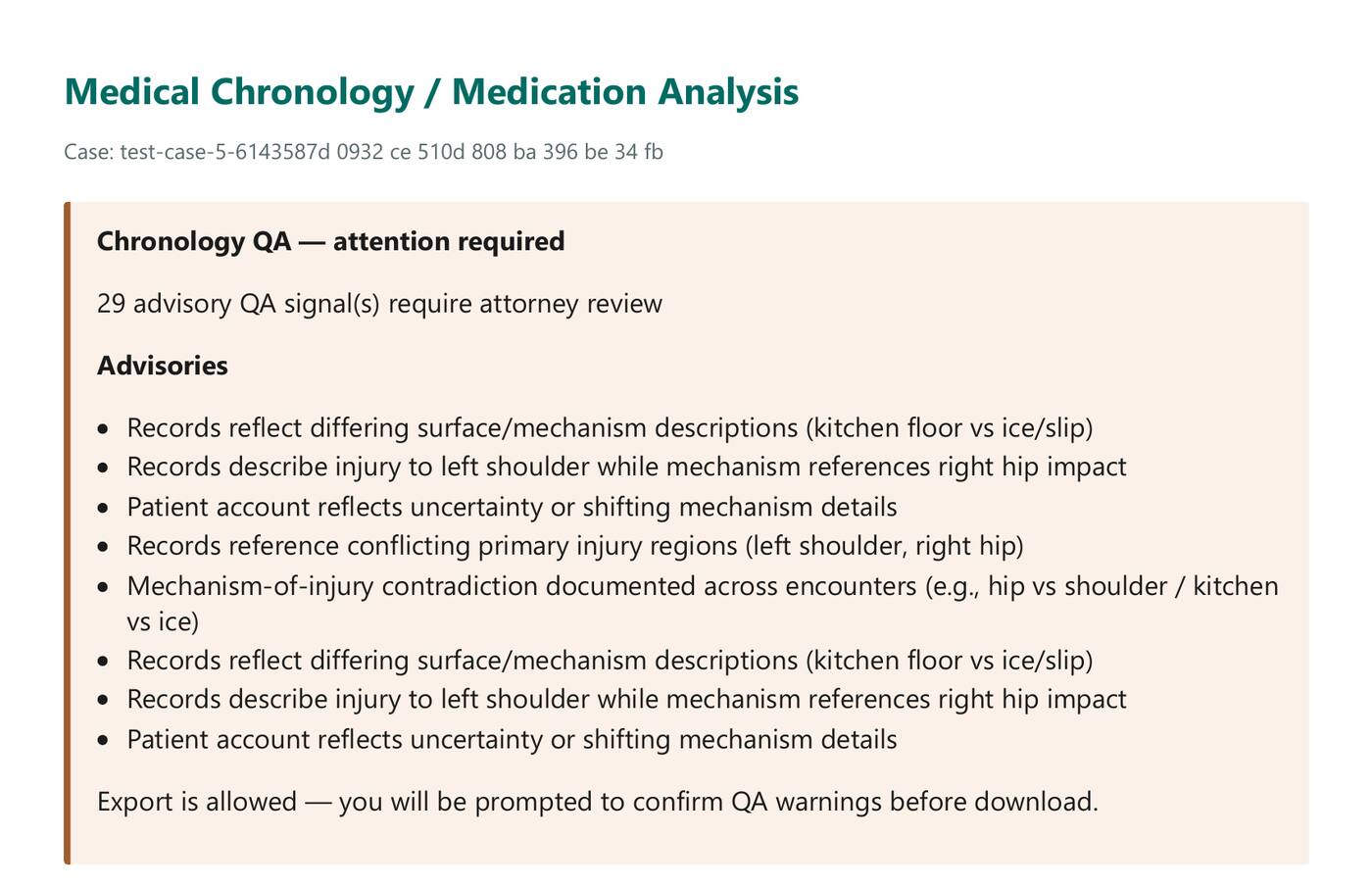
Medical Chronology QA advisories
29 contradictions in the record, surfaced for attorney review — before anyone treats this chronology as settled fact.
Not a vague "inconsistencies found" — she names the exact conflicting details, ready to hand to the treating provider or opposing counsel.
She won't block you from using a flawed chronology — but she won't let you export it without you seeing the warning first.

Medical Chronology — Flags Its Own Contradictions

Conflicting mechanism-of-injury accounts get called out explicitly, not smoothed over into one clean story.

View full report →
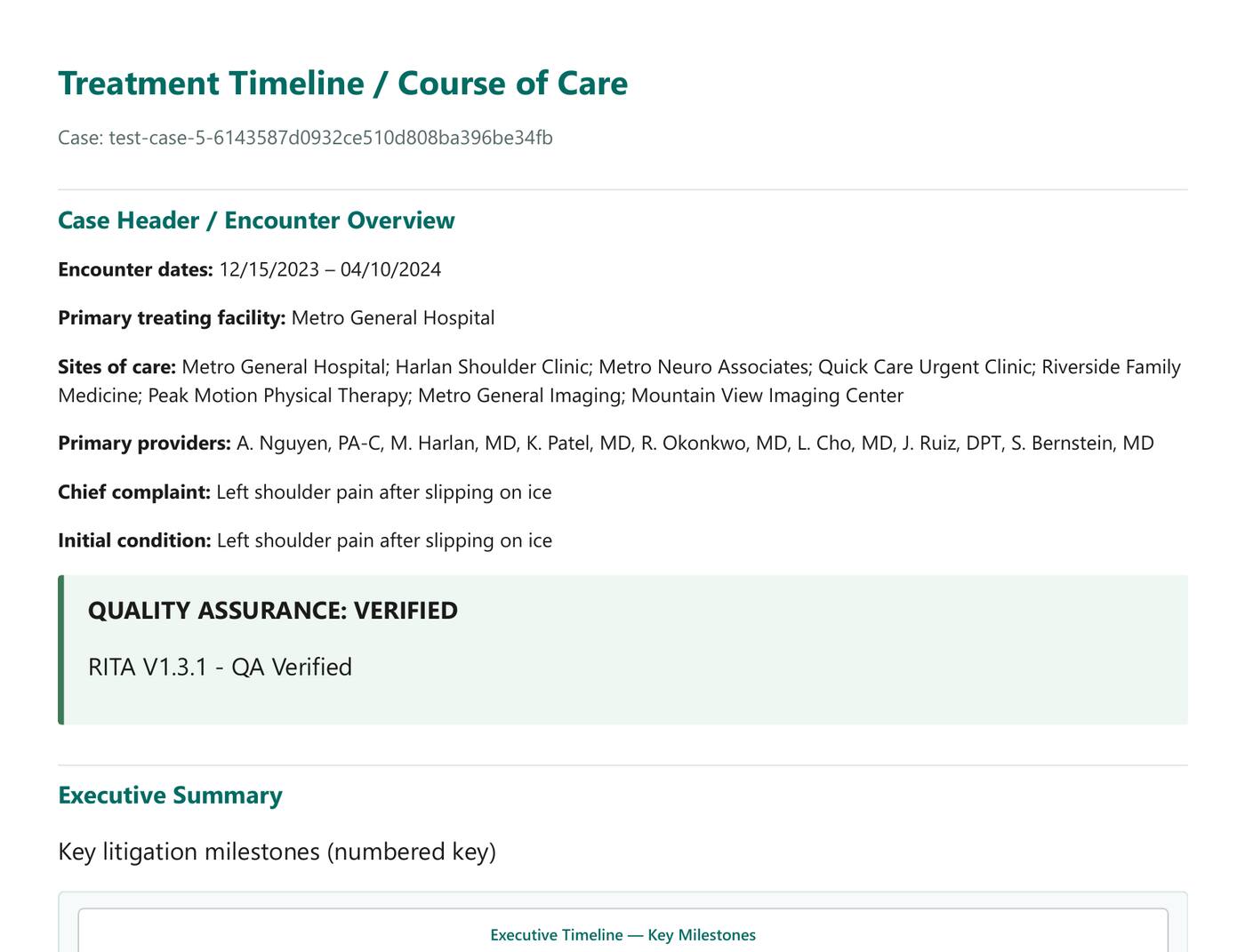
Treatment Timeline QA verified banner
The intake facts sit right above the QA verdict — so you can see exactly what was checked before RITA calls it clean.
Not every report gets flagged. When the record checks out clean, RITA says that too — the same banner, the opposite verdict.
A clean QA verdict doesn't mean the analysis stops — she still builds out the full litigation timeline underneath it.

Treatment Timeline — Verified Clean

The honesty cuts both ways: this one passed every QA check, and the report says so just as plainly.

View full report →
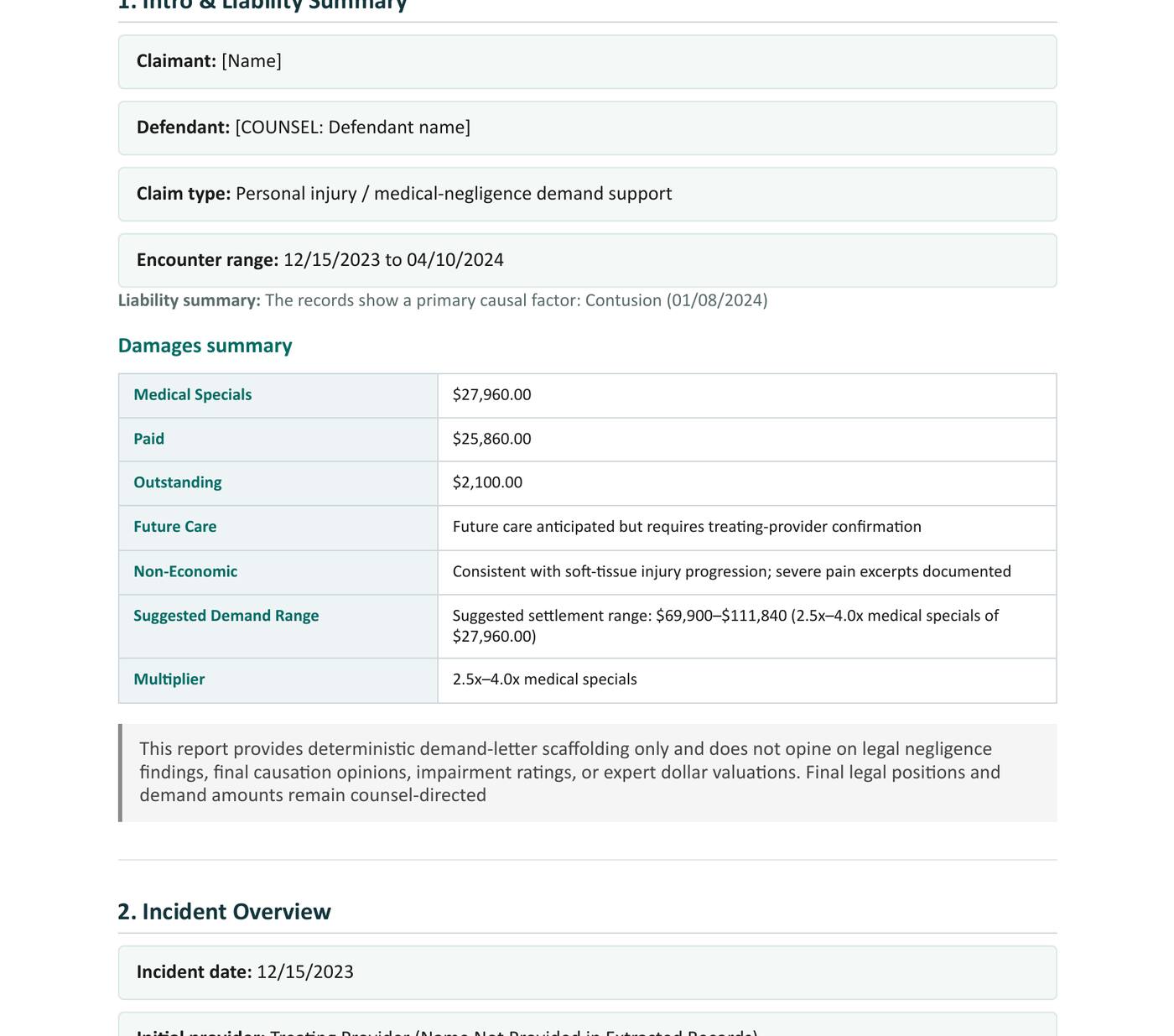
Demand Letter scope disclaimer
Liability language stays narrow and factual — tied to a dated record entry, not an advocate's framing.
The suggested range isn't a guess — it's shown with the exact multiplier and specials figure that produced it, fully auditable.
Even in a letter built to persuade, RITA draws a hard line between her computation and counsel's judgment call.

Demand Letter — Knows Where Her Job Ends

The suggested range is deterministic scaffolding, not a legal opinion — and the letter says so in plain English.

View full report →
The Inquiry & Tactical Layer

Ask her the question you'd ask a second chair.

Twelve reports won't cover every question a case throws at you. When they don't, ask RITA directly in the query section — she doesn't guess at strategy, she surfaces what the record already says, cited back to the page, so you can build the argument yourself. Every answer traces to a document. If it's not in the record, she tells you that too.

Where does the record support future medical costs — and where does it go quiet?
Pulls every documented basis for future care, page by page, and flags the gaps instead of filling them in.
Pull every note that touches the pre-existing condition.
Surfaces the full, cited trail through the chart — not a summary of what she thinks it means.
What does the defense's own expert say that helps us?
Reads the opposing report on its own terms and cites the language, favorable or not.
Show me every gap in the treatment timeline, with dates.
Lists the documented dates on either side of each gap — the record's own silence, not a guess at why.
Where's the weakest point in our causation argument?
Surfaces every contradiction, gap, or unsupported claim on causation that's already sitting in the record, cited — a real vulnerability to prepare for, not a guess at what opposing counsel might argue.